Have you stopped and asked yourself during a training or after the question: what did I actually get out of this? That question probably gets harder to answer the longer the training is. Were there key takeaway moments you missed, or already knew? Unfortunately, this has been the majority of trainings and training design for the better part of a century.
In the meantime, societal attention spans have shrunk at an accelerating rate. If you’re looking for evidence, go look at traffic on TikTok or Instagram. And the topics we need to learn about for productivity are changing faster. There’s no single curriculum course every graduate learns to go into the factory. In fact, even factory conditions are changing faster than we’ve anticipated. I introduce ‘vibe training’ which is essentially dynamically created training at the point in time a user wants to learn.
Why do we need it?
Educating rote topics in a non-deterministic world
Many trainings I’ve designed or completed typically focussed on the how of an activity. You do step 1 to get to step 2, and step 3 requires you to fill out a form to complete the task. Now learn about how the interface is designed to do this. So we learned about an activity, but did we actually take away the significance of the activity? If you did a training like this, you probably knew the significance already: the company needs to process invoices, and you need to do the matching, or the software needs to be deployed a particular way for the corporate environment.
Fun fact: I’ve probably designed close to 100 trainings throughout my career, starting off as a change management consultant before I even touched software development.
The training is designed around process and compliance. How drives uniformity: not creativity.
Yet there’s a cliff in learning currently. If you go down the ‘W’s we learned to evaluate reading, one stands out in particular.
Take a particular course on invoice processing (I built one in 2007):
Who: You
What: Process an invoice by looking at a receipt, an invoice, and determining if the numbers match
Where: In a web portal that you click around in
When: When you get an email notification
Why: Because it’s your job.
How: Follow our process
Pretty terrible ‘why’. Yet, in a world of non-determinism, this is the most important thing we can be learning.
The lost art of ‘why’
I think a root cause in some cases of why we don’t focus on ‘why’ is that in years past, the ‘why’ tended to be transferred from in office cultures and learning. As a new consultant, I sat next to the experienced consultants who, in addition to teaching the process, spent time to educate me about the ‘why’ (sorry for being a terrible listener, Bruce and Linda, but I promise I eventually got it).
Some of this has taken a hit with remote work. It’s harder to get that implicit knowledge. But I’d actually argue that with AI, the need for accelerated pace has forced most ‘teachers’ into learners, and individuals are so focused on their own ability to keep up that transfer learning has become a ‘nice to have’ which means it will never get done.
Applying the TikTok effect to ‘why’ based learning
If TikTok has taught us anything, its that short, to the point videos can capture attention spans for hours. There are typically a few attributes about these:
There’s a good hook. The first ~10 seconds is interesting to you and you will stick around
There’s one or two concepts max. The video isn’t talking about a 45 step process to make Beef Wellington. It’s got one thing you might remember, and that’s it.
They’re short. Hook, get the point (and they get the impression), and you move on.
If we take this concept to training, we talk more and more about ‘snackable’. This just means that the training is short, to the point, and covers at most 1 or two topics.
This training block also happens to be a great way to start building out ‘vibe’ training. In this case, I refer to ‘vibe training’ as generating training on the fly based on what a user needs to learn. We’ll break down the components of ‘vibe training’ next.
Applications like Claude and Gemini offer a newer ‘Learn’ experience built into the app. I find this great for when I have a particular curiosity in mind, but also find these tend to make me struggle with the ‘blank paper’ problem of not knowing what to learn or how to start.
A logical approach to vibe training design
Start with the concept, not the implementation
In vibe training, a key focus is on the ‘why’ of a concept vs. the ‘how’ of implementation. For example, a concept I may want you to learn is how to create a data model. In my training definition, I want to write down notes and links so you learn about the concepts. I’m actively removing the how with a couple methods next:
As you start the training, I may ask a question or two to maximize the relevancy of the training to what you do currently. The goal here is to make it so you can apply the training in your real world scenario as fast as possible.
I’m probably going to have an agent vibe code an interface for the training. For conceptual training, I don’t want you to also be spending a bunch of time learning where all the buttons are. I want you to take away the key concept, and then move on to the next training.
These two points above are important. First, it forces me as a training designer to be very clear about what and why I want you to learn a topic, and I have to be succinct because this training is at max 15 minutes long (think long coffee break activity). Next, because I’m giving an agent or model agency to determine how best to teach this, I’m letting the agent or model decide the best way to show you just what you need to know, and nothing else.
I will call out here an important point. Sometimes it is useful for one of these short trainings to focus on the interface. But if we do that, we’re not teaching concepts. The point of reducing the training time is to only teach you the most important thing you need to know.
Next, map out all the learning topics as a graph
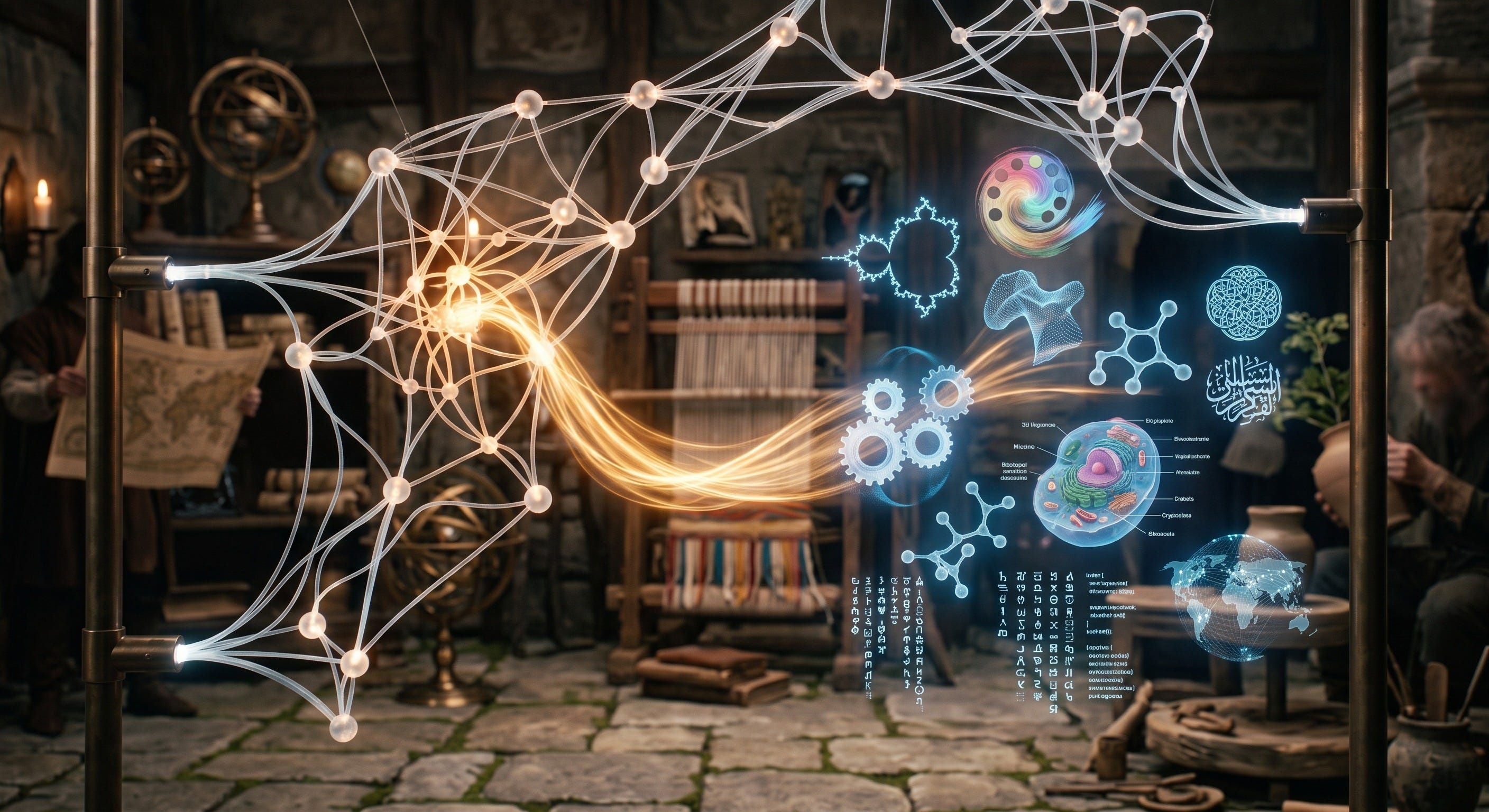
I’ve found that in the era of LLMs, graphs are something we still don’t talk much about, and probably should more. In this instance, if we visualized a graph, all of the entities / nodes would represent the concepts that I want to teach you about.
The entities are the small training concepts that I want to teach, including the takeaway, and any steps about what I would need to measure ‘did you learn’.
The edges represent the relationships between particular entities. For example, if I wanted to teach you to be a data modeling expert, the edges and entities you traverse through may look different than if I wanted to teach you how to be a backend services expert. However, there is still overlap in some components. Edges also represent the contract between each learning component. By validating the inputs to each entity, and the outputs, I can ensure that the graph doesn’t break when we update specific entities within it.
This leads us to a training pattern that is both composable and dynamic. Based on what you know, I can give you any N number of starting points for you to continue through. You’re only learning what you need to learn, and nothing else.
Embracing non-determinism to teach ‘why’
Up to this point, you could take this approach and break down any existing training to make it more dynamic. But I’ve found the power in this type of approach is really about education to the ‘why’ of needing something or teaching a topic like ‘non-determinism’.
Although the system is deterministic in that we can guarantee results via our graph, the user interface is not. Users could ask questions about the training and organically build their own understanding of a topic from the guidance we provide the model in the training node.
In teaching non-determinism, I’ve found you have to use non-determinism to learn about non-determinism. This is a controlled way to provide grounding to a model for teaching but provide a dynamic approach for a user to see how to interact and tune their questions and responses.
Because we’ve removed all the other distractions, focusing on the ‘why’ topics becomes much simpler (and harder as I note in the next point). I’ve been talking more about how, for talks I give, I’ll probably vibe code an interface rather than show you the ones my company has built that you’d use for production. Why? Because I don’t want to spend a minute telling you about all the buttons. If we’ve done that, we’ve lost the plot.
Finally, as a training designer, reducing the time window does something important. It forces me to stop giving you a grab bag of ‘how’ because I have to work to edit the script. If I only have 60 minutes, I can probably let you drive around, weave in some concepts, and hope that something sticks. In the TikTok world, if you have more than a thing or two, the user loses the plot and moves on to someone else to watch. This is very similar here: I have to give you a clearly articulated concept, typically with a why you should care in the hook, for you to keep paying attention.
Forward looking statements about training
When I first said ‘vibe training’ to a colleague, it was intended as somewhat of a joke: is ‘vibing’ really what we want with training? But as I’ve considered more of what vibe coding works, in particular getting from idea to concept, I think there’s a significant relevancy to applying this approach in training design and application. This focuses what we are trying to accomplish on our ideas or curiosity, not getting bogged down in the ‘how’ (which we still may vibe teach). It also gives us as trainers more avenues to teach instead of being locked into a single flow.
As the models continue improving, I suspect that the amount of time we spend teaching ‘what’ continues to shrink. There will be corporate applications that require some level of ‘what’ but we will continue to need to teach broader based concepts so people can continue to be successful, ultimately being the drivers of the creativity and innovation that models allow us to maximize in ourselves.
I plan to share more about how you can design and implement this flow in the coming articles, so stay tuned! Please let me know what your thoughts are and how training has / isn’t working for you as we all go through this together.